Evolution & Systematics
Phylum Mollusca
Placida dendritica belongs to the phylum Mollusca, in the class Gastropoda. There are a number of characteristics that define this phylum and are thought to have been present in the ancestral mollusc. These features include a radula (see Anatomy and Physiology tab: Radula), a shell, a muscular foot, and a mantle with an associated cavity used in respiration and excretion. However, some taxa have secondarily lost one or more of these characteristics.
For example, P. dendritica retains only the radula and muscular foot. The relationships between the classes in this phylum are currently unresolved. A recently proposed phylogeny by Wilson et al. (2010) using molecular techniques placed Gastropoda as the sister group to the monophyletic group Cephalopoda and Scaphopoda (See Phylogenetic Tree 1). However, the class Gastropoda has also been proposed to form a monophyletic group just with Cephalopoda (Ruppert et al. 2004), and also just with Bivalvia (Kocot et al.2011).
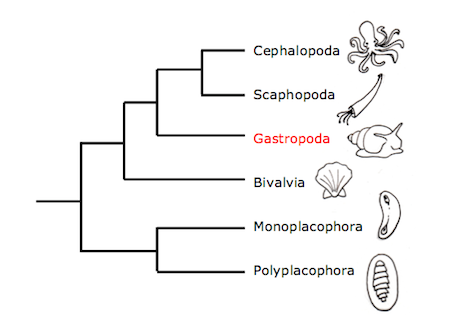
Phylogenetic Tree 1: Proposed phylogenetic tree of the phylum Mollusca, showing possible relationships between the classes. Placida dendritica belongs to the class Gastropoda (in red). Phylogenetic tree drawn by Alison Carlisle, based on relationships constructed by Wilson et al. (2010).
Class Gastropoda
Gastropoda is by far the largest of the Molluscan classes, having undergone enourmous adaptive radiation in the Cambrian explosion around 540 million years ago (Ruppert et al.2004). Gastropods typically display the ancestral molluscan features of a shell, mantle, radula, and foot. Characteristics unique to Gastropods are coiling of the shell and the process of torsion, which is a 180° rotation of the posterior end of the body (the visceral mass, mantle, and shell) during development resulting in the anus being positioned anteriorly above the head as opposed to posteriorly. However, Placida dendritica has undergone detorsion (a reversal of the torsion process).
The phylogenetic relationships of Gastropoda are, like those of Phylum Mollusca, chiefly unresolved. However, the major clades within the Class were determined to some degree by Bouchet et al. in 2005 (see Phylogenetic Tree 2). Phylogenetic tree 2 exhibits three main clades in Gastropoda (Neritimorpha, Caenogastropoda and Heterobranchia) as determined by Bouchet et al. (2005), and the further break down of Heterobranchia into the informal groups of Lower Heterobranchia, Pulmonata and Opisthobranchia. Placida dendritica belongs to the latter of these informal groups.
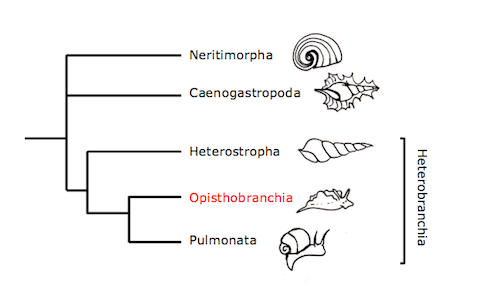
Phylogenetic Tree 2: Proposed phylogenetic tree of some of the major clades that form the Class Gastropoda. Placida dendritica belongs to the clade Heterobranchia, in the informal group Opisthobranchia (in red). Phylogenetic tree drawn by Alison Carlisle, based on relationships constructed by Bouchet et al. (2005).
Informal Group Opisthobranchia
In general, most species in the informal group Opisthobranchia can be characterised by detorsion (reversal of the process of torsion), elaboration of the head, foot or dorsal surface, and a reduction or complete loss of a shell (Waegele & Klussmann-Kolb, 2005). As compensation for the loss of this hard protective covering, many Opisthobranchs subsequently evolved chemical and/or behavioural defences to avoid predation. Within Opisthobranchia sits a number of clades including Sacoglossa (sap-sucking sea slugs), Aplysiomorpha (the sea hares), Cylindrobullida (bubble snails) and Nudipleura (includes the nudibranchs). The relationship between these clades is yet to be determined. Placida dendritica belong to the clade Sacoglossa (see following section: Clade Sacoglossa).
Clade Sacoglossa
Sacoglossa is a monophyletic group of sea slugs and sea snails. The majority of Sacoglossa are sea slugs, many of which look superficially like nudibranchs, however the superfamily Oxynoacea comprises shelled species. Most Sacoglossans are small, ranging from 0.5-3cm in length (Jensen, 1996). They are known as the ‘sap-suckers’ due to their method of feeding, for which their radula (feeding structure) is adapted. They are all specialist herbivores, sucking the ‘sap’ from algae or other marine plants (Clark, 1975). Typically each species of Sacoglossa only feed on one or two genera of plant host. Some Sacoglossans exhibit kleptoplasty, the ability to retain photosynthetic chloroplasts from ingested algae in cells and benefit from the photosynthetic products (Maeda et al. 2010). Whilst Placida dendritica retains chloroplasts in its digestive epithelium, they are not functional.
The relationships between the taxa of Sacoglossa are widely debated. One possible phylogenetic tree proposed by Jensen in 1996, placed the genus Cylinrobulla and superfamily Oxynoacea in the basal branches of the tree. A tree constructed by Handeler & Wagelei in 2007 supported this placement, however the relationships between the families within the superfamily Limapontiodea (Polybranchiidae, Heraediae and Limpntiidae (formerly Stiligeridae)) remain unclear (see Phylogenetic Tree 3).
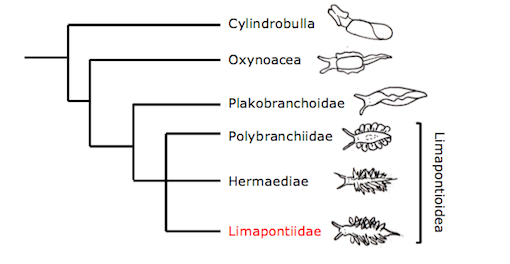
Phylogenetic Tree 3: Proposed phylogenetic tree of the various taxonomic groups that form the clade Sacoglossa. Placida dendritica belongs to the family Limapontiidae (in red). Phylogenetic tree drawn by Alison Carlisle, based on relationships constructed by Jensen (1996), and Handeler & Wagelei (2007).
Family Limapontiidae
The family Limapontiidae comprises eight genera (see Phylogenetic Tree 4). All species in all genera are slug-like, most have a pair of rhinophores (anterior tentacles with a chemosensory function) and many have cerata (dorsal appendages). All species within the genera are specialist sap-sucking feeders on algae. Placida dendritica belongs to the genus Placida.

Phylogenetic Tree 4: Proposed phylogenetic tree of the genera that form the family Limapontiidae. Placida dendritica belongs to the genera Placida (in red). Phylogenetic tree drawn by Alison Carlisle, based on relationships constructed by Jensen (1996).
Genus Placida
When first described by Alder and Hancock in 1845, P. dendritica was placed in the genus Hermaea. Now, Placida dendritica sits within the genus Placida, along with eleven other species. All species are similar in morphology, however, cerata vary in length and shape, and species vary in colour from dark green to a light green-yellow. See the Physical Description tab for details on the external characteristics of P. dendritica.
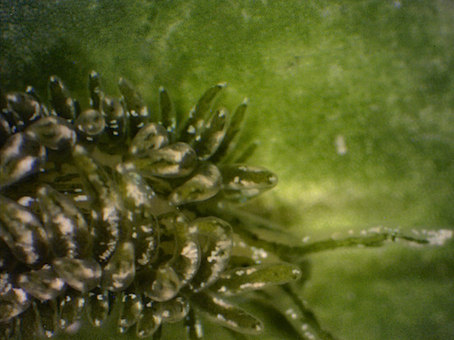
Photo (a): Placida dendritica specimen from Heron Island, Australia. Photo taken by Alison Carlisle.
|